Art history traces fashion’s evolution through shifting perceptual lenses. Impressionism fostered fluid drape and momentary light, shaping garments that read changeable surfaces. Cubism introduced angular seams and structured forms, reframing silhouette logic. Surrealism and Dada injected whimsy and performative detail, widening wardrobe symbolism. Global motifs—Marrakech, North Africa—expanded texture and palette, while Milanese craft anchored precision. The dialogue between these movements reveals how style negotiates perception, structure, and culture, inviting closer scrutiny of what garments ultimately signify.
What Fashion Gains From Impressionist Ideas
Impressionist ideas accelerated a shift in fashion away from rigid, historical silhouettes toward a more fluid, perceptual approach to dress.
This analysis tracks gradual departures from tight corsetry and structured lines to looser volumes, inspired by plein air observation.
Impressionist color and brushstroke texture inform fabric choices, layering, and movement, enabling garments that read as evolving perceptions rather than fixed forms.
Cubist Lines to Tailored Silhouettes
In the wake of Impressionist-influenced shifts toward fluid form, Cubist Lines to Tailored Silhouettes chronicles how angular geometry and multi-angled perception began to reconfigure garment structure. The movement advances from fragmented planes to structured seams, revealing cubist geometry within drape and seam. Chronology shows designers pursuing tailored elegance through reduced volumes, disciplined lines, and reimagined silhouettes aligned with perceptual complexity.
Surrealism, Dada, and the Playful Wardrobe
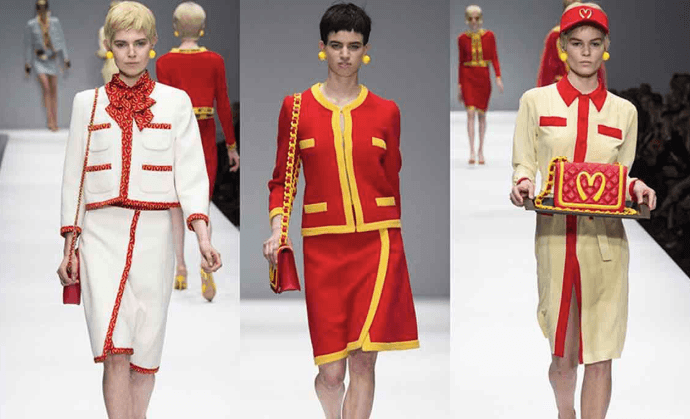
Surrealism and Dada reframed fashion as a site of chance, absurdity, and subversion, where garments functioned less as stable concealment than as acts of visual gesture. The period charts a chronological unraveling: avant-garde designers harness surrealist textiles to disrupt function, while playful wardrobes reveal whimsical closet dynamics as social commentary, shaping later reinterpretations of craft, rebellion, and freedom.
Global Motifs: From Marrakech to Modern Runways
Global motifs extend the conversation beyond Western avant-garde boundaries, tracing how textiles, silhouettes, and color palettes borrowed from Marrakech and North African markets permeated European and American runways.
Chronological framing reveals mid-20th century exchanges, then renewed late-20th-century integrations, culminating in contemporary collaborations.
Milanese craft anchors precision, while urban ambivalence reframes impact, signaling cross-cultural dialogue that reshaped material language and stylistic expectations.
Frequently Asked Questions
How Did Pop Art Influence Bold Color Choices in Fashion?
Pop art influenced bold colors by saturating palettes and crisp contrasts, shaping fashion graphics amid consumer culture; designerspaced chronologically, noting shifts from ironic prints to mass-market optimism, interpreting bold color choices as cultural commentary rather than mere decoration, freedom-driven experimentation.
Which Architectural Movements Shaped Structural Design in Garments?
Architectural expressionism and structural geometry shaped garments through deliberate form, exploring expressive silhouettes and modular constructs; chronologically they emerged from modernist experiments, matured in mid-century to postmodern discourse, offering emancipation from conventional tailoring while emphasizing durable, architectonic lines.
Can Bauhaus Principles Be Seen in Everyday Wardrobe Practicality?
Bauhaus practicality informs the everyday wardrobe through minimal lines and functional fabrics; objections about rigidity are answered by flexibility and modularity. Chronologically, principles trace from design reform to contemporary wear, yielding contextual interpretation for an audience seeking liberated, utilitarian style.
See also: The Future of Wearable Technology
How Do Futurism Aesthetics Translate Into Movement and Textiles?
Futurism kinetics manifests as accelerated silhouettes and geometric seams, translating into textile velocity through dynamic weaves and directionally biased fabrics; chronologically, early futurist motifs give way to consumer-ready elasticity, while contextually, freedom-loving audiences interpret motion as empowering, disruptive aesthetics.
What Role Did Minimalism Play in Contemporary Accessories?
Minimalism influenced contemporary accessories by favoring restrained forms and essential materials; in early phases, function trumped ornament, while later iterations embraced pared-down silhouettes within contemporary minimalism, enabling versatile, constitutive pieces that emphasize sustainability, modularity, and freedom of personal expression.
Conclusion
In tracing fashion’s dialogue with art, the theory that movement dictates function holds partially true: Impressionism informs sensorial drape, while Cubism imposes structure. Chronology clarifies how Surrealist whimsy and Dada performativity destabilize expected wardrobes, inviting theatricality. Contextual interpretation reveals global motifs expanding texture and meaning beyond Western canon, yet Milanese precision anchors audacity in craft. Thus, the archive supports a layered claim: art’s evolving vocabularies recalibrate garment language, but silhouette remains tethered to technique and cultural exchange.